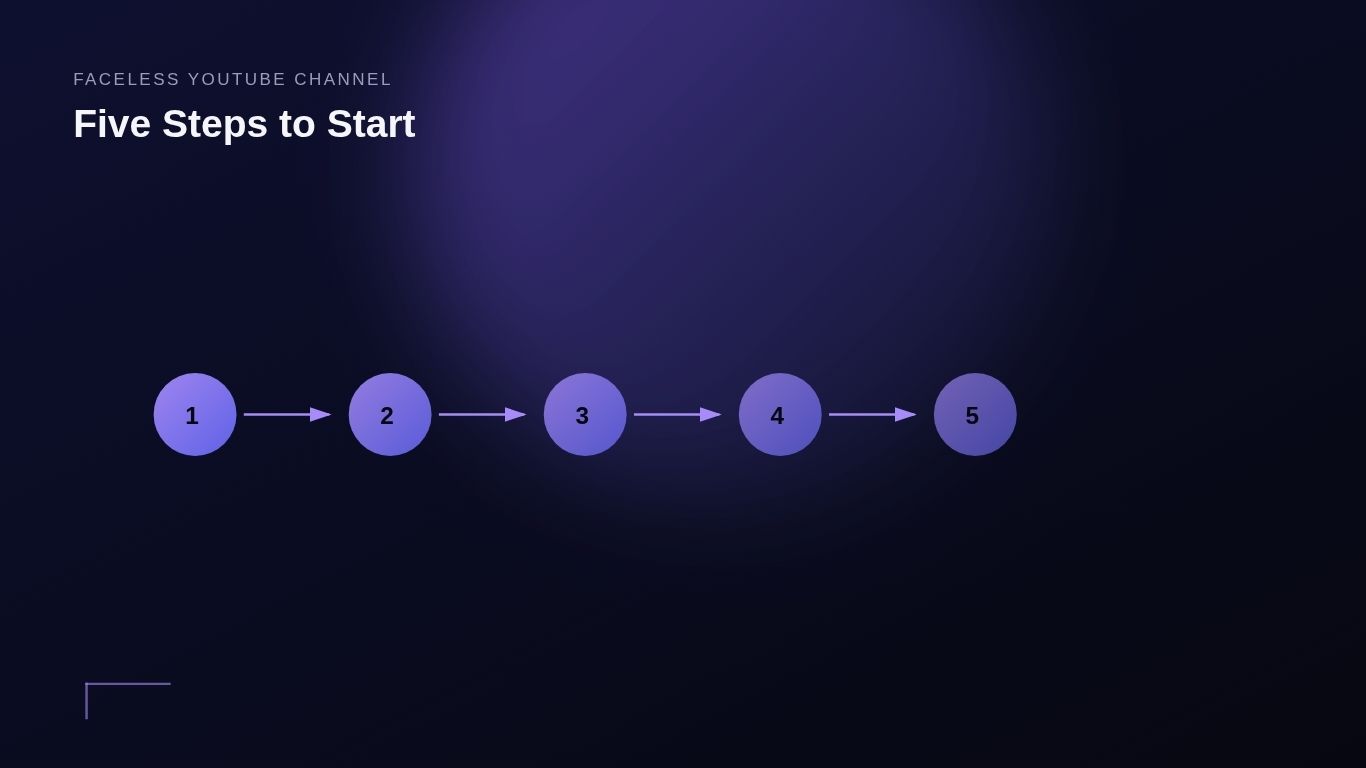
How to start a faceless YouTube channel comes down to five things done in order: pick a niche with real depth, build a minimal production pipeline, produce five videos before publishing any of them, launch on a fixed schedule, and read the retention data from those first five before making any more. Everything else — which AI voice tool, which editing software, which niche is “best” — matters far less than getting this sequence right.
Most guides to this topic are a lead-in to a specific tool pitch. This one is the sequence itself, written from the perspective of someone who’s actually run a faceless production system, not sold one. (For the full growth framework beyond just the starting sequence, see The Ultimate Guide to Growing a Faceless YouTube Channel.)
Quick summary:
- Pick a niche that passes a depth test before anything else — most channels stall from a thin niche, not bad production
- Build the smallest working version of a production pipeline, not a polished one, before the first video
- Produce five videos before publishing any of them, to catch pacing problems before an audience does
- A fixed weekly schedule beats an ambitious one you can’t sustain past month two
- The retention graphs on the first five videos are more useful than the view counts
What you actually need before starting
Not a full studio setup — three decisions made once, before video one, that everything else builds on:
- A voice. A creator’s own recorded voice, a hired voice actor, or an AI-generated voice — the choice matters less than picking one and staying consistent with it across every video.
- A visual style. A defined look for images, color treatment, and pacing that carries through every video, so the channel builds visual recognition even without a face attached to it.
- An editing template. A reusable project structure — intro length, caption style, transition style — that removes a hundred small decisions from every future video instead of re-deciding them each time.
None of these need to be perfect on day one. They need to exist and stay consistent, because consistency is what actually builds recognition — not any single polished choice.
Step 1: Pick a niche that passes the depth test
The single biggest reason faceless channels stall isn’t production quality — it’s a niche that runs out of material by video fifteen. Before committing to anything, check it against three questions:
- Can 50 distinct video ideas be listed without repeating? Struggling past 15 means the niche is too narrow to sustain a channel.
- Do people actually search for this, or does it only work as suggested content? Both can work, but they call for different early strategies.
- Is this genuinely researchable, or already well understood? A niche requiring expertise that isn’t there yet shows in the quality within a few videos.
(A full list of proven niches and formats is covered in 50+ Faceless YouTube Channel Ideas That Actually Make Money.)
Step 2: Build the smallest working production pipeline
Not a polished system — a minimal one that can actually ship a video end to end. That means picking, once, before starting: one voice (own, hired, or AI-generated), one consistent visual style, and one editing template. The goal at this stage isn’t quality, it’s having every stage of the pipeline exist at all, so the first five videos reveal where the real problems are instead of getting stuck on a decision that was never going to matter much either way.
This is the same principle behind any workflow automation — build and test the smallest version first, not the whole system at once. A five-stage production pipeline built and shipped once, end to end, teaches far more than a perfect plan that’s never been run.
Step 3: Produce five videos before publishing any of them
This is the step almost everyone skips, and it’s the one that prevents the most damage. Scripting and producing five videos in a batch, before any of them go live, surfaces pacing problems, tone inconsistencies, and pipeline bottlenecks while the audience is still zero — instead of learning those lessons in public, one disappointing video at a time.
Batching also builds real production speed. The first video in a batch of five always takes the longest; by the fourth or fifth, the same pipeline runs measurably faster, because the decisions that slowed the first one down are already made.
Step 4: Publish on a fixed, sustainable schedule
Pick the highest frequency the pipeline can actually sustain without cutting corners — and then commit to that exact cadence for at least three months before considering a change. A channel publishing reliably once a week for three months outperforms one that publishes daily for two weeks and then goes quiet, because inconsistency resets whatever trust the algorithm and any early subscribers were starting to build.
Weekly is a reasonable default for a one-person operation running a new pipeline. It’s frequent enough to build momentum and slow enough that quality doesn’t collapse under the pace.
Step 5: Read the retention data before making video six
View count says almost nothing about what to fix. Two numbers from the first five videos matter far more:
- Audience retention graphs. A steep drop in the first 15 seconds means the hook isn’t working. A steady decline throughout means the pacing is the problem — two different fixes.
- Click-through rate on impressions. If YouTube is showing the video but almost nobody’s clicking, the thumbnail and title need work — the content itself hasn’t even been tested yet by that measure.
Checking these after each of the first five videos, not just once at the end, shows whether a problem is a one-off or a pattern worth fixing in the pipeline itself.
Common mistakes when starting a faceless YouTube channel
Publishing video one before scripting videos two through five. This is the single most common shortcut, and it’s the one most likely to produce an inconsistent, disappointing early run.
Choosing a “safe” broad niche instead of a specific one. A broad niche feels lower-risk but produces generic content that struggles to build the search or suggested signal a tight niche gets almost automatically.
Over-investing in equipment or tools before the first five videos exist. The production system matters far more than the specific tools behind it — a great pipeline with basic tools beats a mediocre pipeline with expensive ones.
Judging the channel by video three. Growth on a faceless channel compounds slowly at first. The first month is a data-gathering exercise, not a verdict.
Frequently asked questions
How to start a faceless YouTube channel with no experience?
Start with the depth test on a niche, build the smallest working version of a production pipeline (one voice, one visual style, one editing template), script and produce five videos before publishing any of them, and publish on a fixed weekly schedule. Experience isn’t a prerequisite — a defined sequence is.
How much does it cost to start a faceless YouTube channel?
Costs are almost entirely software and time, not hardware — voice generation, image generation, and editing tools, most with free or low-cost tiers to start. The production system matters far more than the budget behind it.
How long before a faceless YouTube channel starts growing?
It depends on niche depth and how quickly the production pipeline stabilizes, not a fixed timeline. A channel with a tight niche and a working pipeline from the first five videos tends to see traction faster than one that spends months searching for a consistent format.
Summary
Starting a faceless YouTube channel is a sequence, not a single decision: pick a niche that passes the depth test, build the smallest working pipeline, batch five videos before publishing any of them, commit to a sustainable schedule, and read the retention data before producing more. Skipping the batching step is the single most common and most avoidable mistake in this whole sequence.
Ready to build your production system?
A System Audit reviews your planned production process and flags exactly where it’s likely to break first. Book a System Audit ($99) →
