
AI marketing automation is marketing work that runs on a mix of fixed rules and AI judgment instead of a person manually executing every campaign step. It’s not a single tool or platform — it’s an approach, and most of the confusion around the term comes from vendors using it to mean whatever their specific product happens to do.
That vagueness is the actual problem worth solving here. Before picking a tool, it helps to have a clear framework for what AI marketing automation is actually doing under the hood — because “AI marketing automation” covers everything from a simple email trigger to a system that writes and tests its own ad copy, and those need completely different levels of oversight.
Quick summary:
- AI marketing automation isn’t one thing — it spans the same three tiers as any other workflow: manual-but-faster, rule-based, and AI-agent
- Most marketing tasks people call “AI automation” are actually simple rule-based triggers with an AI label attached
- The tasks that genuinely benefit from AI judgment are ones involving language, personalization, or decisions with real ambiguity — not simple if-this-then-that triggers
- Small teams get more value starting with 1-2 well-defined AI marketing tasks than trying to automate an entire funnel at once
- A human review step matters more here than in most automation, because marketing output is public-facing and mistakes are visible immediately
Why the term “AI marketing automation” is so confusing
Search for this topic and most results are vendor pages describing their own product as “AI marketing automation,” regardless of whether AI is doing anything genuinely different from a standard rule-based trigger. A tool that sends an email when someone abandons a cart isn’t using AI judgment — it’s a Tier 2 rule, the same as any workflow automation trigger, just wearing an AI-branded label because that sells better in 2026 than it did five years ago.
That’s not a criticism of those tools — rule-based automation is genuinely useful. It’s a clarification worth making before spending money on something marketed as “AI” that isn’t doing anything an AI label needed to justify.
The three tiers, applied to marketing
The same framework that applies to any workflow automation applies directly to marketing work — because marketing automation is a specific application of the same underlying idea.
Tier 1: Manual, but faster. A marketer using templates, saved replies, or a content calendar to move faster through repetitive tasks. Not automation in the strict sense, but often the right place to start — it forces a real understanding of what the marketing process actually involves before any part of it gets handed off.
Tier 2: Rule-based marketing automation. “When X happens, send Y.” A new subscriber gets a welcome email. An abandoned cart triggers a reminder three hours later. A lead that fills out a form gets tagged and routed to a specific list. This is the vast majority of what’s actually sold as “marketing automation,” AI-branded or not — reliable, cheap to build, and completely predictable because there’s no judgment involved.
Tier 3: AI-agent marketing automation. This is where a system makes a judgment call rather than following a fixed rule — writing a first draft of ad copy in a specific brand voice, scoring which leads are actually worth a sales call based on behavior patterns, or personalizing an email’s subject line based on what’s historically worked for a similar audience segment. This tier requires defining what “good” looks like, the same way any AI agent needs a standard to judge against — a vague brief produces vague, generic output.
| Marketing Task | Tier | Why |
|---|---|---|
| Welcome email on signup | Tier 2 | Fixed trigger, fixed action, no judgment needed |
| Lead scoring by behavior | Tier 3 | Requires weighing multiple signals — a judgment call |
| Ad copy first drafts | Tier 3 | Language generation within a brand voice standard |
| Social post scheduling | Tier 2 | Fixed timing, fixed content — no judgment involved |
| Campaign strategy decisions | Tier 1 | High-stakes, ambiguous — stays with a person |
Where AI marketing automation actually pays off for small teams
Enterprise marketing teams have the headcount to run a dozen automated workflows in parallel. Small teams and solo operators get more value picking one or two tasks and doing them well, rather than automating an entire funnel at once.
First-draft content generation. Ad copy, email subject lines, or social captions — AI drafts a starting point in a defined brand voice, and a human edits before anything ships. This is a genuine Tier 3 use case: the judgment call is which draft direction fits, and that stays with a person.
Lead qualification. Instead of manually reviewing every inbound inquiry, an AI agent can flag which leads match a defined “good fit” profile and route the rest to a lower-priority follow-up. The same client-intake pattern used in workflow automation generally, applied specifically to marketing intake.
SEO and content research. Pulling keyword data on a schedule is Tier 2. Deciding which keyword is actually worth writing about, given a site’s current authority and content gaps, is a Tier 3 judgment call — the same distinction covered in the workflow automation framework, applied to content strategy specifically.
Segmentation and personalization. Grouping an email list by simple criteria (location, signup date) is Tier 2. Deciding which message angle will resonate with a specific behavioral segment is closer to Tier 3, because it requires a judgment call about what that segment actually responds to.
Why human review matters more here than in most automation
An automated workflow that makes an internal process slightly wrong is a quiet problem. Marketing automation that makes a mistake is public — a poorly personalized email, an off-brand ad, or a tone-deaf social post goes out to real people immediately, and there’s no quiet fix once it’s sent.
This changes the risk calculus for Tier 3 marketing automation specifically. A Tier 1 human approval step before anything public-facing ships isn’t optional caution here — it’s the difference between an AI-assisted draft and an AI-generated mistake with a real audience. The higher the stakes of a mistake being visible, the more that review step earns its place, even if it slows the pipeline down slightly.
Writing a brand voice standard an AI agent can actually follow
The single biggest reason Tier 3 marketing automation produces generic output isn’t the AI — it’s a missing or vague brief. “Write in our brand voice” isn’t a standard; it’s a placeholder for one. A usable brand voice standard needs three things:
- Specific examples of good and bad. Two or three real pieces of past content marked as “this is the voice” and one or two marked “this isn’t” — an AI agent (or a new hire) learns faster from contrast than from adjectives like “friendly” or “professional.”
- Concrete rules, not vibes. Sentence length preferences, whether contractions are used, whether humor is allowed and what kind — specific enough that two different people applying the standard would produce similar output.
- A defined “no” list. What the brand voice never does — never uses exclamation points, never makes unverified claims, never uses a specific competitor’s name — is often more useful than the “yes” list, because it catches the mistakes that damage trust fastest.
Once that standard exists, it’s reusable across every Tier 3 marketing task — content drafts, ad copy, social captions — rather than being rebuilt from scratch each time.
Measuring whether AI marketing automation is actually working
The same monitoring discipline that applies to any workflow automation applies here, with one addition specific to marketing: audience-facing metrics matter as much as internal efficiency metrics.
- Edit distance on Tier 3 drafts. How much does a human editor actually change before an AI-generated draft ships? A high, unchanging edit distance over time means the brand voice standard isn’t working — the system isn’t learning the pattern, it’s just producing a starting point that needs a full rewrite every time.
- Engagement and conversion versus the pre-automation baseline. AI-assisted content or personalization should hold steady or improve engagement, not quietly erode it. A dip after introducing AI-generated content is a signal to revisit the brand voice standard, not to assume the audience just changed.
- Lead quality, not just lead volume. For AI-driven lead scoring specifically, tracking how many AI-flagged “good fit” leads actually convert reveals whether the scoring model reflects reality or just a plausible-sounding guess.
Reviewing these monthly — the same cadence recommended for any automated workflow — catches drift before it shows up as a visible drop in results.
A real example: AI marketing automation applied to content strategy
Content strategy is a useful case study because it splits cleanly across all three tiers, and the split isn’t obvious until it’s mapped out.
Pulling keyword search volume and competition data on a recurring basis is Tier 2 — a fixed process against a fixed data source, no judgment required. Deciding which of those keywords is actually worth writing about, given a site’s current authority and what’s already ranking, is Tier 3 — it requires weighing search volume against realistic competition, which is a judgment call, not a lookup.
In practice, that means: an automated pull surfaces the raw numbers, but a human (or an AI agent working against a clear standard for “winnable”) decides what to prioritize. Skipping that judgment step and writing purely by search volume produces a content plan full of keywords that will never realistically rank — the same mistake covered earlier about automating a task that isn’t the actual bottleneck. The bottleneck in content strategy usually isn’t gathering keyword data; it’s judging which data actually justifies the writing time.
Getting started: picking your first AI marketing task
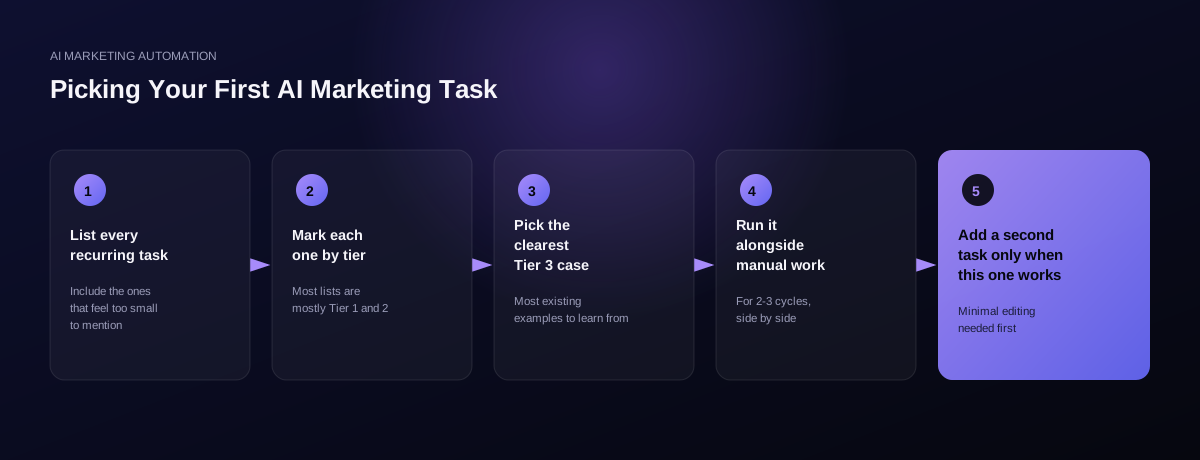
The mistake covered above — trying to automate an entire funnel at once — is avoidable with a simple selection process for the first task to actually automate:
- List every recurring marketing task done in a typical month. Include the ones that feel too small to mention — a weekly social caption, a monthly newsletter intro, a recurring lead-qualification call.
- Mark each one by tier, using the framework above. Most lists turn out to be mostly Tier 1 and Tier 2, with only a handful of genuine Tier 3 candidates.
- Pick the Tier 3 task with the clearest existing standard to judge against. A task with three years of past examples to draw a brand voice standard from is a better starting point than one with no history to learn from yet.
- Run it manually alongside the automated version for two to three cycles. Comparing an AI-assisted draft against what would have been written manually, side by side, is the fastest way to calibrate whether the standard is actually working before removing the manual version entirely.
- Only add a second automated task once the first one needs minimal editing. Scaling to more tasks before the first one is reliable just multiplies the same brand voice problem across more surfaces at once.
Common mistakes with AI marketing automation
Automating a task that was never actually the bottleneck. Automating social scheduling when the real problem is that nobody has time to write strategy in the first place doesn’t fix anything — it automates the wrong layer of the problem.
Skipping the brand voice standard. Tier 3 AI-generated content without a clear, written brand voice guide produces generic output that needs a full rewrite anyway, eliminating the time savings that justified using AI in the first place.
Removing human review to save time. Given how public-facing marketing output is, this is the highest-risk mistake on this list — an unreviewed AI-generated post that misses the mark is far more visible than an internal process error.
Trying to automate the whole funnel at once. Small teams see faster, more reliable results picking one or two genuinely well-defined tasks first, rather than automating lead intake, content, and follow-up simultaneously with no track record of any of it working yet.
Frequently asked questions
What is AI marketing automation?
AI marketing automation is marketing work that runs on a mix of fixed rules and AI judgment instead of a person manually executing every step. It spans a spectrum from simple rule-based triggers (an email sent after a form submission) to AI agents making judgment calls (drafting ad copy in a brand voice, or scoring which leads are worth a sales call).
How is AI marketing automation different from regular marketing automation?
Regular marketing automation is almost entirely rule-based — fixed triggers producing fixed actions, with no judgment involved. AI marketing automation adds a tier where the system makes a judgment call within a defined standard, such as personalizing content or evaluating lead quality, rather than just following an if-this-then-that rule.
Do small businesses actually need AI marketing automation?
Not universally, and not for everything. Small teams generally get more value picking one or two well-defined, high-repetition marketing tasks — like first-draft content generation or lead qualification — rather than trying to automate an entire funnel with AI before proving any single piece works reliably.
What are examples of AI marketing automation?
Common examples include AI-assisted first drafts of ad copy or email subject lines, behavior-based lead scoring, personalized content recommendations, and AI-driven audience segmentation — each requiring a human review step before anything public-facing ships.
Summary
AI marketing automation isn’t a single product category — it’s the same three-tier framework used across any workflow automation, applied to marketing tasks specifically. Most of what’s sold under this label is Tier 2 rule-based automation with an AI-branded name attached. The genuine Tier 3 opportunities — content drafts, lead scoring, personalization — are real, but they need a defined standard for “good” and a human review step before anything public-facing ships, because marketing mistakes are visible the moment they happen.
Ready to find your team’s actual AI marketing opportunity?
A System Audit reviews current marketing processes and flags exactly which tasks are genuinely worth AI-assisting first. Contact us.
