

A faceless YouTube channel is one where the creator never appears on camera and often doesn’t use their real name — the content is built from visuals, narration, and editing rather than a person talking directly into a camera. The brand is the content and the production system, not a personality.
Most guides to this topic are lists of forty niche ideas with no framework behind them. This one is different — everything below comes from actually running a production system, including the thumbnail decisions, the mistakes that cost views, and the ones that mattered less than they felt like at the time.
Quick summary:
- A faceless YouTube channel is one where the creator’s identity isn’t the product — the content and production system are
- Growth comes from three levers: search visibility, click-through rate, and watch time. Most creators overinvest in one and ignore the other two
- A repeatable production pipeline matters more than any single video — consistency compounds, one-off wins don’t
- Pick a niche with real content-idea depth — a topic that supports 50+ videos, not 10
- Monetization eligibility works identically to on-camera channels — there’s no separate bar to clear
Why faceless channels work now
Three things changed that make this a genuinely good time to start a faceless YouTube channel.
Production got dramatically cheaper. Voice generation, image generation, and AI-assisted video editing collapsed the cost and time of producing a polished video from days to hours. A one-person operation can now output what used to require a small crew.
The audience doesn’t care if you’re on camera. Viewers watch for the story, the information, or the entertainment — not the creator’s face. A well-researched history video or a sharp analysis piece gets watched the same whether there’s a face in frame or not.
It scales without burning you out. An on-camera creator is the bottleneck — sick, tired, or camera-shy, and production stops. A faceless channel’s bottleneck is the production system, which means it can run on a schedule instead of on someone’s energy that day.
Why most “faceless YouTube ideas” lists don’t actually help you grow
Search for this topic and most of what ranks is a list of niche ideas — forty options with a sentence each, no framework for picking between them, and no explanation of what to do once a niche is chosen. That’s useful for brainstorming and genuinely not useful for building a channel that survives past video ten.
Ideas are cheap. The gap is almost always in what happens after the idea: no production system, no understanding of what actually drives YouTube’s algorithm to show a video to more people, and no plan for what to measure when growth stalls. That gap is what the rest of this guide covers.
The three things that actually grow a faceless YouTube channel
Most advice about growing a channel is a grab-bag of tips. In practice, everything that matters rolls up into three levers, and knowing which one is actually broken saves months of guessing.
1. Search and suggested visibility. Does YouTube’s algorithm know who to show a video to? This comes from the title, description, tags, and — most heavily — from how well a video matches what people who watched similar videos also watched. A channel with no clear niche confuses this signal. A channel with a tight, consistent topic makes it easy.
2. Click-through rate (CTR). Once YouTube decides to show a video to someone, does the thumbnail and title actually earn the click? This is a completely separate skill from making good content, and it’s the one most new faceless channels underinvest in. A formula that works reliably: a clear visual focal point, a sense of tension or contrast, and 2-3 words of text that don’t just repeat the title.
3. Watch time and retention. Did the click turn into someone actually watching? This is where the video itself has to deliver — a strong hook in the first 15 seconds, no dead air, and pacing that doesn’t let attention drop. A high CTR with poor retention actually hurts a channel over time, because YouTube reads it as a mismatch between promise and delivery.
| Lever | What it controls | Where it breaks | Fastest fix |
|---|---|---|---|
| Search & Suggested | Whether the algorithm shows the video at all | A niche that’s too broad or inconsistent | Tighten the niche, fix titles and descriptions |
| Click-Through Rate | Whether an impression becomes a click | A weak or generic thumbnail | Redesign around a clear focal point and contrast |
| Watch Time & Retention | Whether a click becomes real watch time | A slow hook or inconsistent pacing | Rewrite the first 15 seconds, tighten the edit |
Most channels that stall are strong on one lever and weak on the other two. A faceless YouTube channel with great research and terrible thumbnails gets buried. One with amazing thumbnails and thin content gets a spike of clicks and then a retention cliff that kills momentum.
Building a real production pipeline
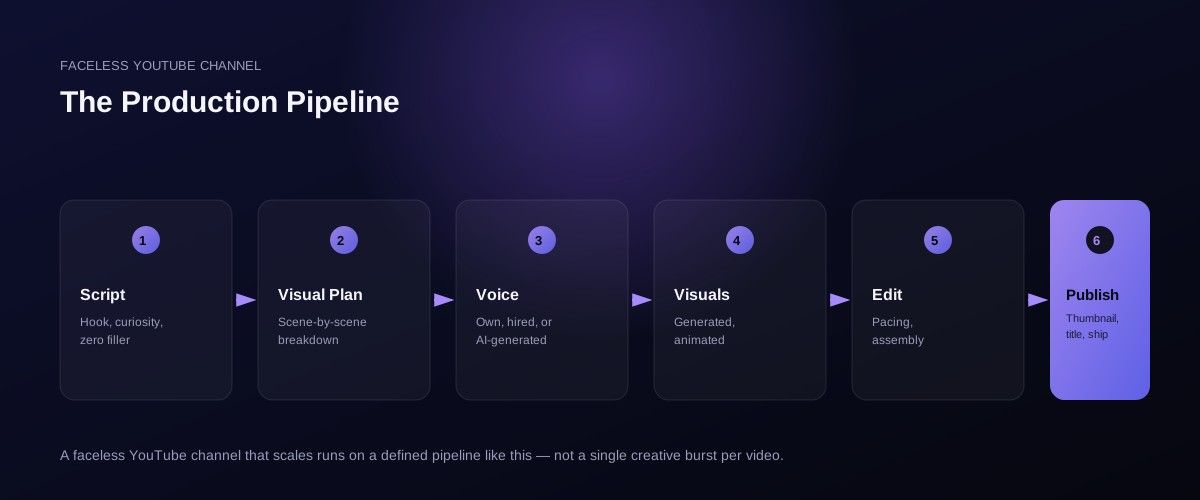
A single great video doesn’t build a channel. A repeatable system that reliably produces good videos does. Here’s the pipeline that actually holds up at volume, broken into stages:
Script. Written to hook in the first line, build curiosity, and eliminate filler. Every sentence should earn its place — if it doesn’t add information or tension, cut it.
Visual planning. The script gets broken into scenes, each with a clear visual description. This is the step most new creators skip, and it’s why their videos feel like a slideshow instead of something cinematic — there was never a plan for what the viewer sees moment to moment.
Voice. Either a creator’s own recorded voice, a hired voice actor, or an AI-generated voice matched to the tone of the content. Consistency matters more than which option gets picked — the same voice across videos builds channel recognition even without a face.
Visuals and animation. Images generated or sourced per scene, then animated or edited together with pacing that changes every few seconds — static, unmoving visuals are the fastest way to lose a viewer’s attention.
Edit and assembly. Voice, visuals, music, and pacing come together. This is where retention either holds or breaks, based on how tightly the edit matches the energy of the script.
Thumbnail and title. Designed last, once the finished video is known in full — not before. A thumbnail that promises something the video doesn’t deliver tanks retention even if it wins the click.
Treat each stage as its own defined step with a clear handoff to the next one, the same way any other workflow automation gets mapped — because that’s exactly what a production pipeline is. A vague handoff between stages is where quality quietly erodes as volume scales up.
Batch by stage, not by video. Writing one script, then producing one full video, then writing the next script is slower and lower-quality than it looks. Writing five scripts in one sitting, then generating visuals for all five, then handling voice for all five, removes the context-switching that wastes the most time in a casual production process.
AI voice or your own voice: how to actually decide
This decision gets treated as a philosophical question when it’s really a practical one. Three factors settle it in most cases:
Publishing volume. Recording, or re-recording, a script by hand caps how many videos can realistically go out per week. AI-generated voice removes that ceiling, which matters more the higher the target cadence is.
Voice fit for the content. Some formats — comedic, highly personal, or reaction-style content — lean on a distinctive human voice that’s hard to replicate. Others — narrated history, explainer, or research-driven content — work well with a clean, consistent AI voice, because the story carries the video more than vocal personality does.
Consistency over quality alone. A slightly less “perfect” voice used consistently across every video builds more channel recognition than an excellent voice that changes tone, pacing, or energy between uploads. Whichever option gets picked, the same voice profile and delivery style should carry through every video — that consistency is what turns a voice into a recognizable part of the brand, not the raw audio quality of any single upload.
Testing both approaches across three or four videos each, then checking retention side by side, settles the question with real data faster than debating it in the abstract.
Publishing cadence: how often is actually enough
There’s no universal magic number, but there is a wrong way to think about it: picking a cadence that isn’t sustainable past month two. A channel publishing reliably once a week for a year outperforms one that publishes daily for three weeks and then goes silent for two months — inconsistency resets the trust the algorithm and the audience both build up around a schedule.
Pick the highest frequency the production pipeline can sustain without cutting corners on script quality, thumbnail quality, or retention-focused editing — then hold that line for at least three months before deciding whether to increase it. A slower, consistent cadence beats a fast, inconsistent one every time this gets tested.
Reading analytics without getting lost in vanity metrics
View count is the least useful number on a dashboard for deciding what to fix. Three metrics actually reveal which of the three growth levers is broken:
- Impressions and impression click-through rate point to Lever 2 — if impressions are healthy but CTR is low, the thumbnail and title aren’t doing their job, not the content.
- Average view duration and audience retention graphs point to Lever 3 — a steep early drop-off means the hook isn’t working; a steady decline throughout means pacing is the problem.
- Traffic source breakdown (search vs. suggested vs. browse) points to Lever 1 — a channel with almost no search traffic has a discoverability problem no amount of thumbnail work will fix.
Checking these after every video, not just monthly, reveals patterns across five or six uploads that any single video’s numbers can’t show.
Picking a faceless YouTube channel idea that actually lasts
The single biggest reason faceless channels stall isn’t production quality — it’s picking an idea that runs out of material after fifteen videos. Before committing to a niche, check it against three things:
- Depth. Can fifty distinct video ideas be listed in this niche without repeating? Struggling past fifteen means the niche is too narrow.
- Search demand. Do people actually search for this topic, or does it only work as a suggested/browse play? Both can work, but they need different strategies.
- Sustainable expertise. A niche requiring deep knowledge that isn’t there yet will show in the quality within a few videos. Pick something researchable thoroughly, or already well understood.
How to start: the first 5 videos
Getting a faceless YouTube channel off the ground doesn’t require a perfect system on day one — it requires a system good enough to ship five videos without falling apart.
- Pick a niche that passes the depth test above
- Build a minimal version of the production pipeline — one voice, one visual style, one editing template
- Script and produce five videos before publishing any of them, to catch pacing or tone problems before an audience does
- Publish on a fixed schedule, even if it’s just weekly — consistency signals to the algorithm and to early subscribers that the channel is active
- Watch the actual retention graphs on those first five, not just the view counts — they show which stage of the pipeline needs the most work
Monetization: what to expect
YouTube’s Partner Program has fixed eligibility requirements, based on subscriber count and either watch hours or Shorts views, reviewed against YouTube’s official monetization policies. Faceless channels are eligible on the same terms as any other channel — there’s no separate bar to clear for not showing a face on camera. The realistic timeline depends entirely on how well the three growth levers above are working, not on a fixed number of months.
Common mistakes that stall a faceless YouTube channel
Picking a niche with no depth. Strong first few videos, then a scramble for ideas by video ten. Fix this before starting, not after.
Treating the thumbnail as an afterthought. A great video with a weak thumbnail simply doesn’t get watched. Real time needs to go into this stage, not the last 20 minutes before publishing.
Inconsistent voice or visual style. Viewers build recognition through consistency. A channel that changes its visual identity every few videos never builds a recognizable brand.
No retention review. Publishing and moving on without checking where viewers actually drop off wastes the most useful data a channel produces every week.
Comparing week 4 to a channel’s year 3. Growth compounds — the first few months usually look slow no matter how good the system is. Judge the trend, not any single video.
Frequently asked questions
What is a faceless YouTube channel?
A faceless YouTube channel is one where the creator doesn’t appear on camera or use their real identity — content is built from visuals, narration, and editing instead of a person talking directly to the camera.
Do faceless YouTube channels make less money than regular channels?
No. Ad revenue, sponsorships, and monetization eligibility work the same regardless of whether the creator appears on camera. What determines revenue is views, retention, and audience size — not visibility of the creator.
Can I use my own voice on a faceless channel?
Yes. “Faceless” refers to not appearing on camera, not necessarily hiding a voice. Many faceless channels use the creator’s real voice; others use a hired voice actor or AI-generated narration.
How long does it take to grow a faceless YouTube channel?
It depends on niche competitiveness and how well the three growth levers — search visibility, click-through rate, and retention — are working, not on a fixed timeline. A tight niche and a solid production system from day one tend to produce faster traction than months spent searching for a consistent format.
What’s a good faceless YouTube channel idea for a beginner?
The best starting niches combine real depth (50+ possible videos without repeating), genuine search demand, and a topic that’s researchable thoroughly or already well understood. Broad categories like history, psychology, true crime, and finance tend to have the deepest well of material, but the specific angle within them matters more than the category itself.
Do I need expensive equipment to start a faceless YouTube channel?
No. A faceless channel’s costs are almost entirely software and time, not hardware — voice generation, image generation, and editing tools, most of which have free or low-cost tiers to start. The production system matters far more than the budget behind it.
Summary
A faceless YouTube channel succeeds or stalls based on three levers — search visibility, click-through rate, and retention — not on finding the perfect niche idea. The faceless YouTube channels that actually grow map their production into a repeatable pipeline, pick a niche with real depth, publish on a sustainable cadence, and review the right analytics after every upload instead of only when growth visibly stops. That’s the difference between a channel that compounds and one that quietly stalls by video fifteen.
Ready to build your own production system?
A System Audit reviews a channel’s current production process and flags exactly which of the three growth levers needs attention first. Contact us.
