Autonomous AI agents are AI systems that pursue a goal through multiple steps on their own — deciding what to do next based on the result of the previous step, rather than following a single fixed instruction. The distinction that actually matters: a regular AI tool responds once per request, while an autonomous agent keeps going, checking its own progress and adjusting its next action until the goal is met or it hits a defined stopping point.
Most explanations of this term come from enterprise software vendors describing their own platform. This one is different — it’s written from the perspective of someone who actually runs bounded autonomous agents in a real production system, not a company selling agent infrastructure.
Quick summary:
- An autonomous AI agent takes multiple steps toward a goal without a person approving each one — that’s the actual definition, not just “AI that does things”
- The core components are a goal, a reasoning loop, memory of what’s already happened, and the ability to use tools or take actions
- Full autonomy is rare and usually unnecessary — most useful agents are semi-autonomous, with a human checkpoint at a defined point
- The real risk isn’t the AI being wrong once — it’s an agent continuing to act on a wrong assumption across many steps before anyone notices
- Small teams get more value from one narrow, well-bounded autonomous agent than from a general-purpose one with a vague goal
In this guide:
Autonomous AI agents vs. a regular AI tool
This is the distinction most explanations skip. A regular AI interaction — asking a chatbot a question, generating one image, drafting one email — is a single request and a single response. The person decides what happens next.
An autonomous AI agent is given a goal instead of a single instruction, and it decides the sequence of steps to get there. Told to “research this topic and produce a content brief,” it might search, read several sources, decide it needs more specific data, search again, then compile a result — without a person approving each step in between, making its own judgment calls based on what it learned from the step before. That’s the actual definition — not “more advanced” or “more features,” but AI that keeps taking steps toward a goal on its own, evaluating its own progress along the way.
The four components every autonomous agent actually has
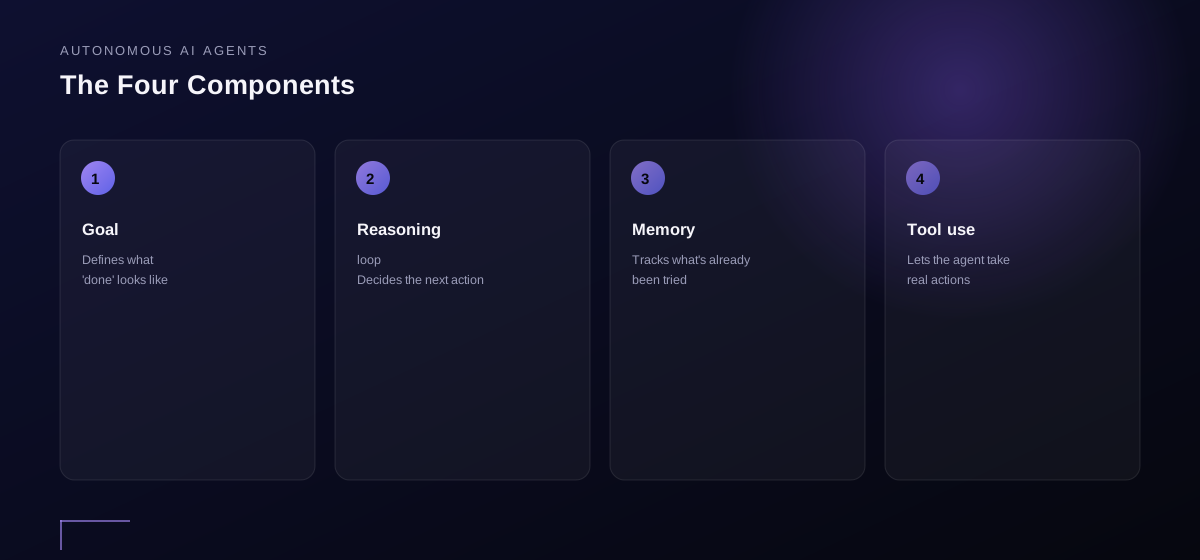
Strip away the vendor language and every one of the autonomous AI agents built today, regardless of platform, is built from the same four parts:
| Component | What it does | What happens without it |
|---|---|---|
| Goal | Defines what “done” looks like | The agent has no way to know when to stop, or what counts as success |
| Reasoning loop | Decides the next action based on the current state | The agent can only follow a fixed script, not adapt to what it finds |
| Memory | Tracks what’s already been tried or learned | The agent repeats steps or contradicts its own earlier decisions |
| Tool use | Lets the agent take real actions — search, write, call an API | The agent can only reason, not actually do anything |
An agent missing any one of these isn’t really autonomous — it’s a more elaborate version of a single-step AI tool. A system with a goal and tool use but no memory, for example, can take real actions but can’t build on what it’s already learned, which caps how far it can get on any non-trivial task.
A real example: a bounded autonomous agent in production
An agent responsible for one specific stage of content production — turning validated keyword research into a structured content brief — is a useful case study, because it shows what “bounded” actually looks like, as opposed to a fully open-ended agent with no real limits.
The goal is narrow: given a target keyword and its search data, produce a brief with a title, outline, target word count, and internal linking suggestions. The reasoning loop checks competition data, decides whether the term is realistic to target, and adjusts the approach — a big-bet pillar page versus a quick-win cluster piece — based on what it finds. Memory tracks which keywords are already assigned, to avoid duplicating a brief across two articles. Tool use is limited to pulling keyword data and cross-checking the existing content queue — nothing broader.
Nowhere in that loop does the agent publish anything, spend money, or make an irreversible decision without a human reviewing the output first — real autonomy within a deliberately narrow scope, not a liability.
Full autonomy is rare — and usually not what you actually want
“Autonomous” gets used as if it’s binary — either an AI does everything itself or a person does everything manually. In practice, almost every useful autonomous agent is semi-autonomous: it runs several steps on its own within a defined boundary, then stops at a checkpoint for a person to review before anything ships or takes effect outside the system — the same principle behind any well-designed workflow automation. An agent that researches and drafts a document, then stops for review before publishing, captures nearly all the time savings of full autonomy with almost none of the risk.
The real risk with autonomous agents
The risk people worry about — the agent doing something obviously wrong — is rarely the actual problem in practice. The more common failure mode is subtler: an agent makes one small wrong assumption early in its reasoning loop, then continues building on that assumption across several more steps before anyone reviews the output, compounding a small error into a much bigger one by the time a person actually looks at it.
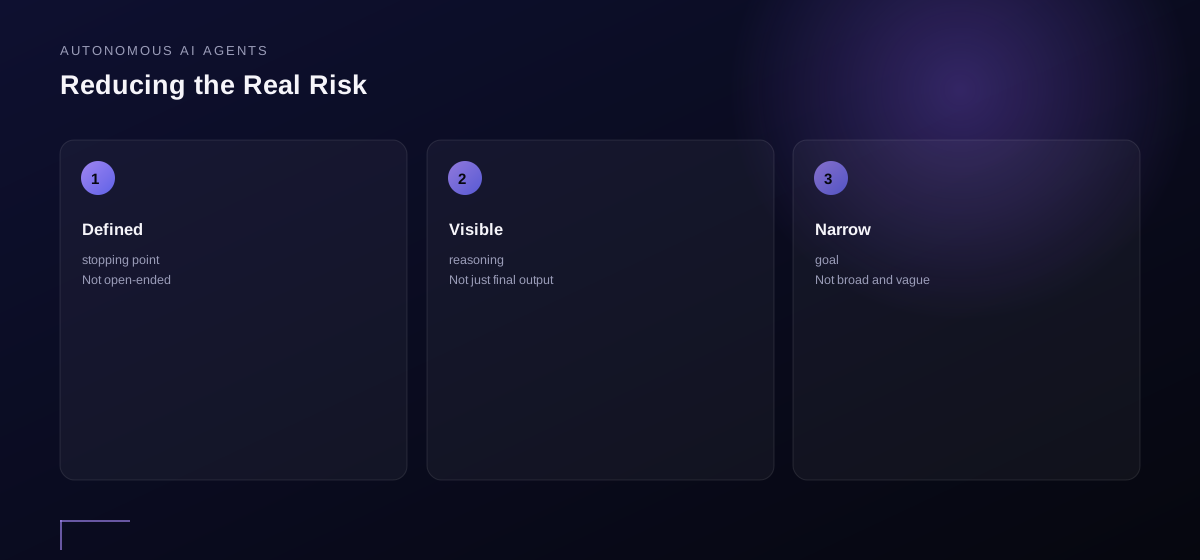
Three things reduce this risk without giving up the benefits of autonomy:
- A defined stopping condition. The agent should have a clear point where it stops and hands off for review, not an open-ended “keep going until it seems done” instruction.
- Visible reasoning, not just a final output. An agent that shows what it searched, decided, and why lets a reviewer catch a wrong assumption early instead of only seeing a polished result that hides how it got there — consistent with published engineering guidance on building effective agents, where simpler, more transparent designs outperform maximally autonomous ones in production.
- A narrow goal, not a broad one. The bounded content-brief example above is low-risk specifically because the goal is narrow — a broad, vague goal leaves far more room for a small error to compound before it’s visible.
Where autonomous agents actually make sense for small teams
Enterprise autonomy use cases involve dozens of integrated systems and dedicated oversight teams. Small teams get more realistic value picking one narrow, well-defined task rather than trying to replicate that scale.
Research and first-draft compilation. An agent gathers information on a topic, checks it against existing content, and produces a structured first draft — the same pattern as the content brief example above, applied to any research-heavy task, close to the Tier 3 pattern covered in AI marketing automation.
Multi-step data validation. Checking a list of items against several criteria, flagging exceptions, and compiling a report — enough steps and judgment calls to benefit from autonomy, narrow enough to stay genuinely bounded.
Monitoring with escalation. An agent that checks defined conditions on a schedule and only surfaces something for human attention when a real threshold is crossed, instead of requiring a manual check every time.
Getting started: building your first bounded autonomous agent
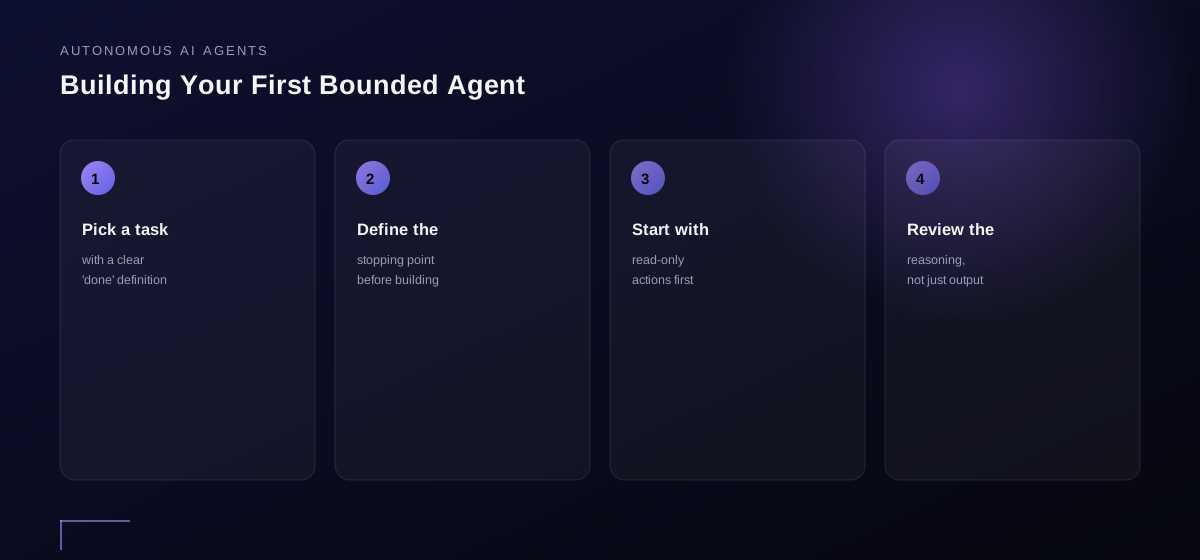
Pick a task with a genuinely clear definition of “done.” If success can’t be described in one sentence, narrow the goal further before building anything.
Define the stopping point before building anything. Decide exactly where the agent hands off to a human, and make that checkpoint non-negotiable.
Start with read-only or low-stakes actions. An agent that can search and draft, but can’t publish, send, or spend, is far safer to test than one with full write access from day one.
Review the reasoning, not just the output, for the first several runs. This is how a wrong assumption gets caught early, before it compounds across many runs.
Widen the scope only after the narrow version is reliable. Prove the smallest version works, the same principle covered in workflow automation, before automating more at once.
Measuring whether an autonomous agent is actually working
An autonomous agent that quietly drifts off-track is harder to catch than one that fails obviously, because the output can still look plausible even when the reasoning went wrong several steps earlier. Three things are worth tracking once an agent has been running for more than a handful of cycles:
- How often the human checkpoint catches a real problem. A checkpoint approved without changes every time either means the agent is genuinely reliable, or the review has become a rubber stamp — worth distinguishing honestly.
- Where in the reasoning chain errors tend to appear. Mistakes clustering around one type of decision point to that part of the reasoning loop needing a tighter standard, not a sign the whole approach is broken.
- Whether the agent’s scope has quietly expanded. A narrow agent often gets asked to handle “just one more thing” until its original bounded goal is gone — checking current scope against the original goal periodically catches this before it’s a real risk.
HD Media Insight: judge an agent by how it fails, not how often it succeeds
A success rate alone is a misleading way to judge whether an agent is safe to trust with less oversight — how the failures look matters more. An agent that fails loudly (an error, an empty result) gets caught at the checkpoint almost every time. One that fails quietly, by confidently producing a plausible but slightly wrong result, is more dangerous at 95% success than a loud-failing agent at 80%, because quiet failures are exactly what a reviewer skims past. When reviewing the first several runs, deliberately feed the agent an ambiguous or edge-case input rather than only watching how it handles normal ones — the fastest way to see which failure mode it defaults to before real volume makes that expensive to find out.
Common mistakes with autonomous AI agents
Giving an agent a broad, vague goal. “Improve our marketing” isn’t a goal an agent can meaningfully pursue — it has no way to know what “improved” means or when it’s done.
Removing the human checkpoint too early. An agent that ran correctly ten times in a row hasn’t proven it’s safe to run unsupervised forever — it’s proven it works for the ten scenarios it happened to encounter.
No visibility into the reasoning steps. An agent that only shows a final output makes a compounding error far harder to catch before it reaches something that matters.
Treating “autonomous” as a feature to maximize. A semi-autonomous agent with a well-placed human checkpoint is often the actually correct design, not a compromise on the way to full autonomy.
Frequently asked questions
What are autonomous AI agents?
AI systems that pursue a goal through multiple steps on their own, deciding what to do next based on the result of the previous step rather than responding once to a single instruction. The key components are a defined goal, a reasoning loop, memory of prior steps, and the ability to take real actions through tools.
What’s the difference between an AI agent and an autonomous AI agent?
The terms are often used interchangeably, but “autonomous” specifically emphasizes multiple sequential steps toward a goal without approval at each step. A basic AI agent might still require a person to approve or trigger each action individually.
Are autonomous AI agents safe to use without human oversight?
Full unsupervised autonomy is rare and usually unnecessary. Most reliable autonomous agents are semi-autonomous — they run several steps independently within a narrow scope, then stop at a clear checkpoint for human review before anything with real consequences happens.
Do small businesses need autonomous AI agents?
Not universally, and not for broad, vague tasks. Small teams get the most value from one narrow, clearly-bounded autonomous agent — such as research compilation or multi-step data validation — rather than attempting enterprise-scale autonomy across many systems at once.
Summary
Autonomous AI agents are defined by taking multiple steps toward a goal without approval at each one — not by being more advanced than a regular AI tool. The four components (goal, reasoning loop, memory, tool use) are consistent across every implementation, regardless of platform. Full autonomy is rarely the right design; a narrow, well-bounded agent with a defined human checkpoint captures nearly all the benefit with far less risk. The real danger isn’t a single obvious error — it’s a small wrong assumption compounding silently across several steps before anyone reviews the result.
Ready to build your first bounded agent?
A free strategy call reviews current processes and flags exactly which task is narrow and well-defined enough to genuinely benefit from an autonomous agent first. Book a Free Strategy Call →
